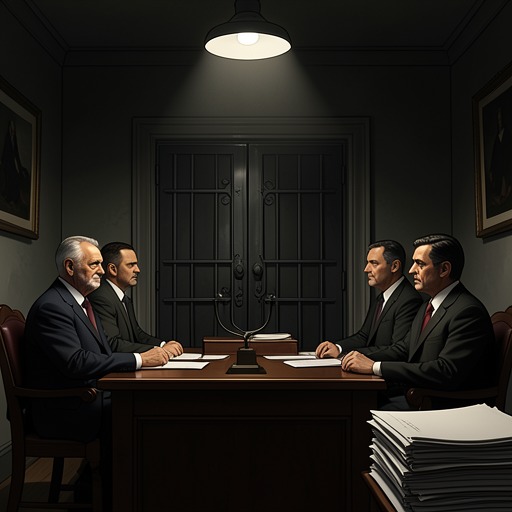
Richard Pellrod
The RainmakerRichard Pellrod is a senior claims examiner at Great Benefit whose testimony brings the company’s internal claims process—and its handling of Donny Ray Black’s claim—before the jury. As Jackie Lemancyzk’s immediate supervisor, he is positioned to explain the department’s practices and to challenge her account. Instead, his testimony exposes the distance between the routine language of claims administration and the consequences of the denial letters he signed.
Position and Role in the Trial
Pellrod has worked in claims for twenty years and supervised Lemancyzk, a former claims handler implicated in the dispute over Great Benefit’s denials. After Payton Reisky testifies for the defense, Leo F. Drummond calls Pellrod, evidently hoping that his account will discredit Lemancyzk. Drummond’s questions portray her as irresponsible and dishonest; Pellrod supplies criticisms of her attendance and conduct at work while also describing the department’s ordinary procedures.
The narrative presents Pellrod as irascible and unable to inspire warmth or trust in the jury. That impression matters in a trial where the defense needs jurors to believe its account of the company’s conduct. His extended presentation does not help: Drummond leads him through a rehearsed explanation of claims processing, while the jurors grow bored. Tyrone Kipler twice urges Drummond to move on, noting that Pellrod’s testimony repeats material already before the jury. The judge’s interventions make the defense’s effort to establish its version feel both prolonged and unpersuasive.
Account of the Claims Department
Pellrod describes the claims manual as a book that changes frequently and says experienced handlers largely ignore it. He claims not to have looked at it in years and says Section U means nothing to him. This posture contrasts with the detailed account he gives when Drummond asks him to walk through a hypothetical claim: Pellrod takes the jury step by step through forms, memos, and the usual channels. His procedural fluency sits uneasily beside his claim that he does not know the manual governing those procedures.
In addressing Lemancyzk, Pellrod says she had a drinking problem, sometimes arrived at work smelling of liquor, missed more work than other handlers, and became increasingly irresponsible. He presents her termination as inevitable. On questions about her sexual conduct, however, he says he knows nothing. The distinction limits his willingness to endorse every accusation against her, even as he supports the defense’s effort to undermine her credibility. His testimony thus offers a portrait of a workplace account assembled selectively: allegations against Lemancyzk are emphasized, while Pellrod disclaims knowledge where he cannot speak from personal experience.
The Fourth Denial Letter
Rudy Baylor’s cross-examination shifts the focus from general procedure to a specific document: the fourth denial letter Pellrod signed and sent to Dot Black. The letter calls Donny Ray’s leukemia a preexisting condition and identifies the flu as the relevant earlier illness. Pellrod recognizes the letter as his. He says it arose from a form Lemancyzk filled out incorrectly and a misunderstanding involving Mr. Krokit, and expresses regret, describing the denial as a mistake.
The details make that explanation difficult to sustain. Pellrod acknowledges that the letter was intended as a final denial, even though four further denial letters followed. Asked when Donny Ray had the flu, he estimates that he was fifteen or sixteen. Pellrod then concedes that he knows of no connection between that bout of flu and the onset of acute leukemia five years later. He agrees that the flu had nothing to do with the leukemia. The cross-examination turns an abstract dispute about claims handling into a direct comparison between the medical condition that caused Donny Ray’s death and the unrelated illness named in Pellrod’s letter.
When Baylor asks whether the letter was a lie or a mistake, Pellrod insists it was a mistake. Drummond objects when Baylor asks whether that mistake helped kill Donny Ray; Kipler overrules him and directs Pellrod to answer. Pellrod continues to call it a mistake, and denies that his testimony is filled with lies or mistakes. The exchange leaves the jury with the contradiction plainly stated: the letter gave a reason for denying the claim that Pellrod has just admitted was unrelated to the disease.
Accountability and Narrative Significance
Baylor’s final question asks Pellrod, as the senior claims examiner, to look Dot in the eyes and tell her that his office handled her son’s claim fairly. Pellrod squints, frowns, glances toward Drummond, and says he does not believe he can be forced to do so. Baylor ends the cross-examination there, having spent less than five minutes on him. Rather than prolong the examination with the manuals and statistics, he has brought the witness back to the letter and to the bereaved claimant it affected.
Pellrod’s courtroom role is limited but consequential. He does not offer a confession of deliberate wrongdoing: he maintains that the denial was a mistake. Yet his answers establish the mismatch at its center, and his refusal to affirm that Dot’s claim was fairly handled gives the jury a revealing final measure of his defense. Set against Dot’s earlier reading of the denial letters and the presentation of Donny Ray’s recorded testimony, Pellrod’s testimony contributes to a larger account of institutional decisions experienced by a family as repeated refusals of help. His section of the trial shows how a defense built on routine paperwork can falter when one signed document is examined against the facts it claims to represent.